Blood Collection Tubes Guide: Additives, Uses, and Color Codes Explained
Views: 0 Author: Site Editor Publish Time: 2026-09-03 Origin: Site
Up to 70% of clinical laboratory errors occur in the pre-analytical phase. Improper sample collection is the primary culprit behind these costly mistakes. Selecting and standardizing the right diagnostic tools is not just a basic clinical requirement. It is a critical operational decision impacting test accuracy, turnaround times, and laboratory efficiency. Poor choices lead to higher rejection rates, delayed diagnoses, and compromised patient care.
This guide details the universal color-coding standards and specific additive mechanisms you need to know. We will also cover objective evaluation criteria required to procure reliable solutions. You will learn how to implement these strict standards to minimize sample rejection rates. By applying these insights, you can optimize laboratory workflows and ensure diagnostic confidence.
Key Takeaways
Standardized color codes indicate specific additives (anticoagulants, clot activators, or gels) dictating the tube's clinical application.
Strict adherence to the Order of Draw is non-negotiable to prevent additive cross-contamination and erroneous test results.
Procurement evaluation must weigh vacuum accuracy, additive-to-blood ratios, material integrity (PET vs. Glass), and regulatory compliance (ISO/CE/FDA).
Effective inventory management mitigates risks associated with tube shelf-life and vacuum degradation over time.
The Clinical and Operational Impact of Blood Collection Tubes
Using poor-quality Blood Collection Tubes carries hidden consequences. Hemolysis, micro-clotting, and subsequent redraws severely frustrate patients. They also delay urgent diagnostic results. Every rejected sample requires a fresh draw. This doubles the labor time and significantly increases the consumption of clinical supplies. Poor tube quality ultimately places unnecessary financial strain on healthcare facilities.
Successful implementation requires clear, measurable goals. You should aim for a standardized inventory and achieve over 99% valid draw volumes. Your chosen products must integrate seamlessly with automated laboratory information systems (LIS). Furthermore, strict adherence to CLSI (Clinical and Laboratory Standards Institute) guidelines remains essential for ongoing compliance. Meeting these criteria ensures smooth, uninterrupted testing.
Tube selection bridges everyday phlebotomy practice and complex analytical chemistry. Procurement decisions must align perfectly with institutional testing menus. You cannot treat these items as mere commodity plastics. They are highly engineered medical devices. When procurement teams recognize this clinical reality, they make smarter purchasing decisions. They select products tailored to specific diagnostic platforms, ensuring maximum analytical reliability.
Decoding Color Codes, Additives, and Clinical Uses
Standardized colors provide an immediate visual cue for healthcare professionals. They indicate the exact additive present inside the container. This dictates the specific testing applications available. Understanding these mechanisms ensures phlebotomists draw the correct sample every time.
Light Blue: Sodium Citrate Blood Collection Tube
These containers feature a light blue closure. They are indispensable for coagulation testing.
Additive & Mechanism: They contain either 3.2% or 3.8% liquid sodium citrate. This additive binds reversibly to calcium ions in the sample. By removing free calcium, it effectively halts the coagulation cascade.
Clinical Use: Laboratories rely on them for coagulation studies. Common tests include Prothrombin Time (PT) and Activated Partial Thromboplastin Time (APTT).
Evaluation Note: Precision is absolutely critical here. You must maintain an exact 1:9 additive-to-blood ratio. Underfilling these units causes a relative excess of citrate. This artificially prolongs clotting times and leads to misdiagnoses.
Procurement teams must rigorously evaluate the vacuum accuracy of any Sodium Citrate Blood Collection Tube. Even slight vacuum deviations ruin the necessary 1:9 ratio.
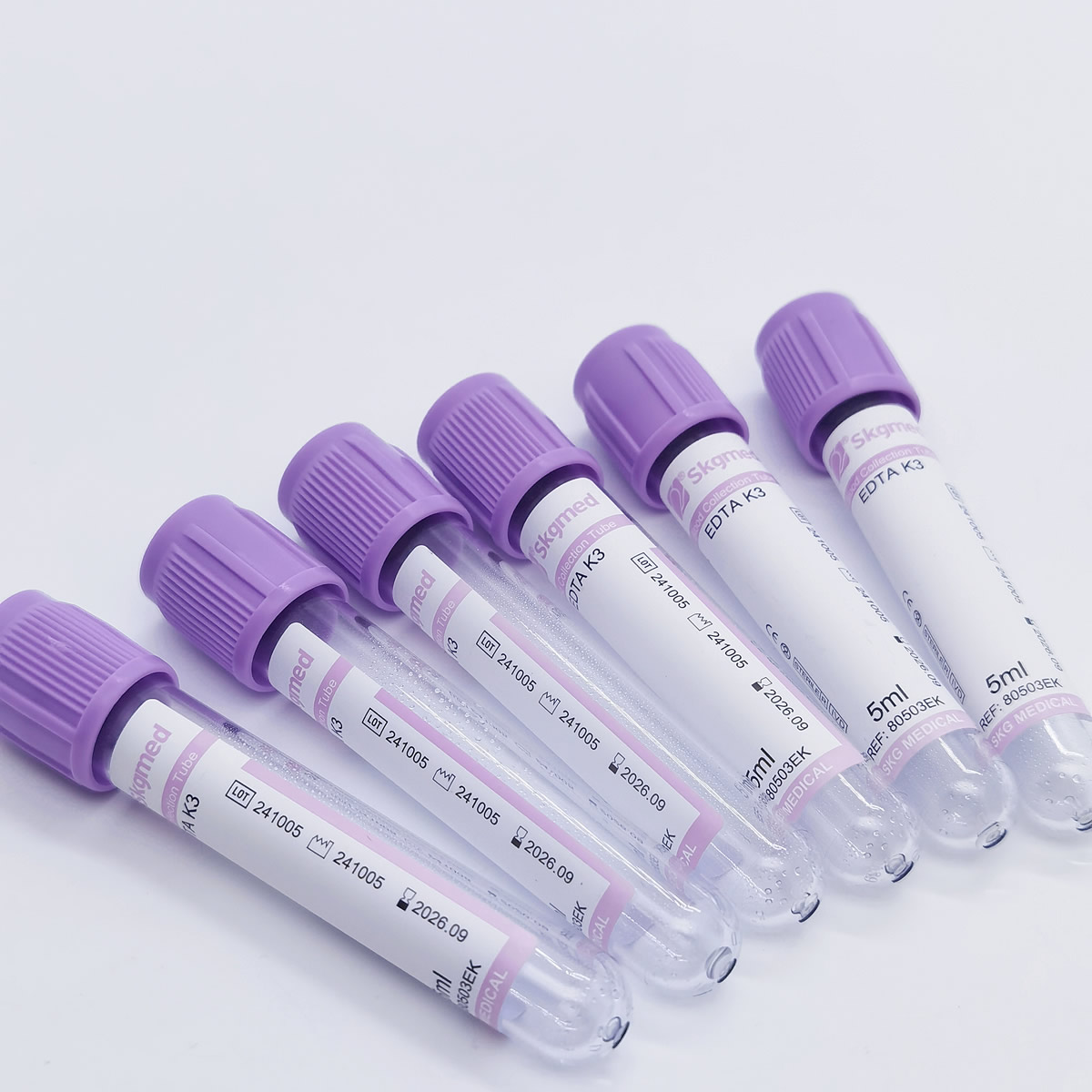
Lavender/Purple: EDTA Blood Collection Tube
The lavender top is a universal staple in hematology departments.
Additive & Mechanism: They utilize either K2 EDTA (dipotassium) or K3 EDTA (tripotassium). EDTA acts as a powerful chelating agent. It binds calcium ions irreversibly to prevent clotting. Unlike other anticoagulants, it preserves cellular morphology exceptionally well.
Clinical Use: Healthcare providers use them for Complete Blood Counts (CBC), blood typing, and HbA1c screening.
Evaluation Note: Proper mixing is vital. Phlebotomists must invert the container gently several times immediately after collection. Failure to do so leads to micro-clot formation. Underfilling an EDTA Blood Collection Tube causes red blood cell shrinkage, which artificially alters hematocrit levels.
Green: Heparin Blood Collection Tube
Green tops serve as the primary choice for rapid chemistry testing.
Additive & Mechanism: They contain either Lithium Heparin or Sodium Heparin. Heparin functions by activating antithrombin. This action strongly inhibits thrombin formation, completely stopping the clotting process.
Clinical Use: They are ideal for routine clinical chemistry panels and plasma determinations. Processing plasma is faster than processing serum because it does not require a waiting period for clotting.
Evaluation Note: Laboratories strongly prefer Lithium Heparin over Sodium Heparin for general chemistry. A sodium-based additive will artificially elevate the patient's sodium levels during electrolyte testing. Therefore, specifying the exact salt form of your Heparin Blood Collection Tube is a crucial procurement detail.
Gold/Tiger Top: Gel Separator Blood Collection Tube (SST)
These units, often called Serum Separator Tubes (SST), revolutionize serum processing.
Additive & Mechanism: They feature a silica clot activator combined with an inert polymer gel at the base. The activator speeds up blood clotting. During centrifugation, the gel moves upward to form a physical barrier between the serum and the cellular clot.
Clinical Use: Technicians use them for serum chemistry, immunology, and infectious disease serology.
Evaluation Note: Gel stability during centrifugation dictates the quality of the sample. A poorly formulated gel can break down or fail to create a distinct physical barrier. This allows cellular metabolites to leak into the serum, ruining the specimen. When sourcing a Gel Separator Blood Collection Tube, evaluate the gel's specific gravity and temperature resilience carefully.
Red (Serum) and Gray (Fluoride/Oxalate)
Red closures indicate plain serum containers. They typically contain no additives, though some plastic versions include a mild clot activator. They are used for baseline serum tests where gel separators might interfere. Gray tops contain potassium oxalate (an anticoagulant) and sodium fluoride (a glycolysis inhibitor). This specific combination preserves glucose and lactate levels. Without it, blood cells would continue metabolizing glucose, causing falsely low test results.
The Standardized Order of Draw: Preventing Cross-Contamination
Phlebotomists rarely collect just one specimen. They usually draw several from a single venipuncture. The sequence in which they fill these containers is strictly regulated. CLSI guidelines dictate a specific Order of Draw to prevent costly pre-analytical errors.
The Universal CLSI Order of Draw:
Blood Culture Bottles
Light Blue (Coagulation)
Red/Gold (Serum / SST)
Green (Heparin)
Lavender/Purple (EDTA)
Gray (Glycolysis Inhibitor)
The science behind this sequence focuses entirely on preventing additive carryover. When a needle pierces a stopper, it can pick up microscopic traces of the additive. If you draw an EDTA sample before a serum chemistry sample, disaster strikes. EDTA contains potassium. Carrying this potassium into the next container falsely elevates the patient's potassium readings. Furthermore, EDTA aggressively chelates calcium and magnesium. This cross-contamination will cause falsely low calcium readings in the subsequent chemistry panel. Such skewed results routinely lead to dangerous misdiagnoses and unnecessary medical interventions.
Purchasing premium supplies solves only half the problem. You must pair high-quality procurement with continuous staff training. Phlebotomy teams need to understand the underlying chemistry. When staff grasp "why" the Order of Draw matters, protocol adherence improves dramatically. This combination of top-tier equipment and robust training guarantees superior outcome improvements.
Key Evaluation Criteria for Procuring Blood Collection Tubes
You must look beyond unit pricing during procurement. True value lies in manufacturing consistency, material stability, and regulatory compliance. Evaluating these physical and operational characteristics protects laboratory integrity.
Material Quality (PET vs. Glass)
Manufacturers traditionally used glass for all specimen collection. Today, Polyethylene Terephthalate (PET) dominates the market. Each material offers distinct advantages and drawbacks. PET provides excellent shatter-resistance. This protects healthcare workers from accidental biohazard exposure. Plastic is also lighter, reducing shipping and disposal costs. However, glass provides an unparalleled vapor barrier. Some highly sensitive assays still require glass to prevent microscopic interactions between the specimen and the plastic wall.
Table: PET vs. Glass Material Comparison
Evaluation Metric
PET (Plastic)
Glass
Shatter Resistance
Excellent (Highly durable)
Poor (Prone to breaking)
Staff Safety
High (Minimal breakage risk)
Moderate (Requires careful handling)
Cost-Effectiveness
High (Lower production & shipping costs)
Lower (Heavier and fragile)
Gas/Moisture Permeability
Slight permeability over long periods
Impermeable (Maintains vacuum perfectly)
Best Application
Routine chemistry, hematology, standard clinical use
Sensitive immunology, specific specialized assays
Vacuum Consistency & Draw Volume
The vacuum inside the container is mechanically calibrated to draw an exact volume of blood. Manufacturing tolerances dictate how accurate this vacuum remains. If the vacuum is too weak, the container under-fills. This directly impacts the crucial additive-to-blood ratio. As previously noted, improper ratios compromise coagulation and hematology results. Procurement teams must request statistical data on vacuum tolerances from potential vendors. Tight manufacturing controls ensure you receive exactly the required draw volume every single time.
Compliance & Manufacturing Standards
Laboratory trust relies entirely on regulatory compliance. You should instantly disqualify any vendor lacking baseline certifications. Look for ISO 6710 adherence, which specifically governs single-use containers for venous blood collection. Furthermore, the manufacturing facility must hold ISO 13485 certification for medical device quality management. Depending on your region, CE marking or FDA clearance is an absolute legal necessity. These certifications prove the manufacturer follows strict quality assurance testing.
Cap Design & Safety
Cap design directly impacts user safety and automated processing. Modern safety-engineered closures feature a rubber stopper covered by a protective plastic shield. This design prevents aerosolization. When technicians open older, basic rubber stoppers, a microscopic mist of blood can spray into the air. Safety-engineered closures eliminate this risk, protecting staff from bloodborne pathogens. Furthermore, the cap dimensions must align perfectly with your laboratory's automated decapping machines. Mismatched caps cause machine jams and slow down testing workflows.
Implementation Risks and Inventory Management
Even the finest supplies fail if poorly managed. Your inventory practices directly influence specimen quality. Medical facilities must recognize that these items have finite lifespans and specific storage requirements.
Shelf-Life Realities
Vacuum degradation over time is a biological reality, particularly for PET plastics. While PET is highly durable, it remains slightly permeable to gases. Over many months, air slowly seeps through the plastic wall, weakening the internal vacuum. Tubes nearing their expiration date may fail to draw the required volume. This under-filling leads directly to rejected samples. Procurement managers must rotate stock strictly using a First-In, First-Out (FIFO) method. Never hoard excessive inventory that might expire before use.
Storage Conditions
Environmental factors severely damage sensitive additives. Extreme heat can degrade gel separators, causing them to liquefy or lose their specific gravity. If this happens, the gel will not form a proper barrier during centrifugation. Extreme cold can similarly compromise PET integrity, making it brittle. You must store all supplies in climate-controlled environments, adhering strictly to the manufacturer's recommended temperature ranges.
Shortlisting Logic
Selecting a new vendor requires careful validation. We recommend the following shortlisting protocol:
Request Validation Samples: Never commit to a bulk contract based on paper specifications alone. Secure hundreds of sample units for real-world testing.
Conduct Comparative Testing: Run side-by-side tests using your existing automated analyzers. Compare the results from your current supplier against the new samples. Look for any discrepancies in chemistry values or cellular morphology.
Audit Supply Chain Resilience: Assess the vendor's ability to deliver consistently. Ask about their raw material sourcing and backup manufacturing facilities. Supply chain interruptions halt laboratory operations entirely.
Conclusion
Blood collection tubes are highly engineered diagnostic tools, not simple commodity plastics. Matching the exact additive and color code to the specific clinical requirement serves as the foundation of laboratory accuracy. Ignoring these standards guarantees elevated rejection rates, skewed test results, and compromised patient care. You must view procurement through a clinical lens, valuing manufacturing consistency and regulatory compliance above basic unit pricing.
Your next steps are clear. We encourage lab managers and procurement teams to jointly audit current specimen rejection rates. Identify exactly which tests face the highest redraw requests. Next, review your current supplier's quality control data and vacuum tolerances. Finally, request product samples from top-tier manufacturers to conduct internal validation testing. By taking these proactive steps, you can significantly enhance your facility's diagnostic reliability.
FAQ
Q: Why is the Order of Draw so critical for blood collection tubes?
A: The Order of Draw prevents additive carryover between specimens. When a needle pierces a tube, it picks up microscopic traces of the internal chemical. If drawn out of sequence, an additive like EDTA can contaminate a subsequent serum tube. This cross-contamination causes severe analytical interference, such as falsely elevating potassium levels and leading to dangerous medical misdiagnoses.
Q: What happens if an EDTA Blood Collection Tube is under-filled?
A: Under-filling causes an excessive concentration of the EDTA additive relative to the blood volume. This excess aggressively draws water out of the red blood cells, causing them to shrink. This cellular shrinkage artificially lowers the patient's hematocrit levels and alters mean corpuscular volume (MCV), invalidating the Complete Blood Count (CBC) results.
Q: Can I use a Sodium Citrate Blood Collection Tube for a CBC?
A: No. Sodium citrate is strictly for coagulation testing because its calcium-binding effect is reversible, which is necessary for clotting timing tests. A CBC requires EDTA because it preserves cellular morphology flawlessly while irreversibly preventing clotting. Using citrate for a CBC would distort cell size and invalidate the hematology results.
Q: How long is the shelf life of a standard vacuum blood collection tube?
A: The standard shelf life typically ranges from 12 to 18 months from the manufacturing date. Over time, plastic tubes experience vacuum degradation because PET material is slightly permeable to air. As air slowly enters, the vacuum weakens, increasing the risk of under-filling if the product is used near or past its expiration date.