Cryovial vs. Centrifuge Tube: When to Use Each for Sample Storage
Views: 0 Author: Site Editor Publish Time: 2026-08-11 Origin: Site
Improper sample storage carries catastrophic operational risks. When a vessel ruptures in liquid nitrogen, you lose more than a single biological sample. You compromise years of research, waste valuable lab resources, and introduce severe safety hazards to your personnel.
Both cryovials and centrifuge tubes hold liquid specimens. However, their structural tolerances support entirely different phases of the laboratory workflow. Misunderstanding these differences often leads to compromised sample integrity. Manufacturers engineer specific polymer blends for either extreme thermal shock or intense mechanical stress. You cannot use these items interchangeably without inviting procedural failure.
This guide provides an evidence-based framework for evaluating these crucial laboratory consumables. We will explore structural engineering differences, temperature thresholds, and downstream processing capabilities. You will learn how to standardize your storage protocols to protect your most critical biological assets.
Key Takeaways
Temperature Thresholds: Use a cryovial for ultra-low temperature preservation (down to -196°C in vapor phase liquid nitrogen). Use laboratory centrifuge tubes for ambient, refrigerated, or moderate freezing (-20°C to -80°C) depending on the polymer grade.
Structural Purpose: Centrifuge tubes are engineered to withstand high Relative Centrifugal Force (RCF) for sample separation; cryovials are engineered for thermal shock resistance and absolute seal integrity over decades.
Safety & Compliance: Using non-cryogenic tubes in liquid nitrogen introduces severe explosion risks due to liquid seepage and rapid expansion upon thawing.
Selection Logic: Storage duration, extreme temperature exposure, and downstream processing (like spinning down cells) dictate the correct vessel choice.
Defining the Baseline: Structural Engineering and Core Functions
Misclassification of tubes often occurs in busy laboratories. Users assume polypropylene construction guarantees universal compatibility. Polypropylene is indeed used in both vessel types. However, polymer blends, wall thickness, and cap designs dictate very strict functional limits. We must understand these structural baselines to prevent sample loss.
The Cryovial (Cryogenic Storage Vials)
Manufacturers design a cryovial exclusively for long-term preservation and biobanking. These vessels serve as the ultimate vault for high-value biological assets. They undergo rigorous engineering to withstand extreme thermal shock. Dropping a tube from room temperature into a deep freeze environment causes massive material stress. Cryovial polymers remain elastic enough to prevent shattering under these extreme conditions.
Furthermore, these vessels are typically limited to smaller volumes. You will mostly find them in 1.0mL to 5.0mL capacities. This specific sizing optimizes freezing and thawing rates. A smaller volume ensures uniform temperature distribution across the sample. Uniformity prevents ice crystal formation, which otherwise destroys delicate cellular structures during the cryopreservation process.
Laboratory Centrifuge Tubes
Laboratories rely on laboratory centrifuge tubes for processing, separation, and short-to-medium-term storage. Unlike archival vessels, these tubes support active benchwork. Engineers design them to handle massive physical stress. They must endure high g-forces (RCF) during spinning without mechanical failure. Wall thickness and bottom geometry are specifically molded to distribute centrifugal loads.
You can find them in versatile formats to suit different workflows. Common sizes include 1.5mL microcentrifuge tubes, 15mL conical tubes, and 50mL conical tubes. This versatility makes them indispensable for day-to-day sample preparation. However, their structural focus on mechanical strength often sacrifices extreme low-temperature resilience.
Selecting the right consumable requires matching physical features to desired outcomes. We must evaluate three critical dimensions to ensure sample security.
Seal Integrity and Leak Prevention
Seal failure ruins experiments and destroys valuable samples. The sealing mechanism differs vastly between vessel types.
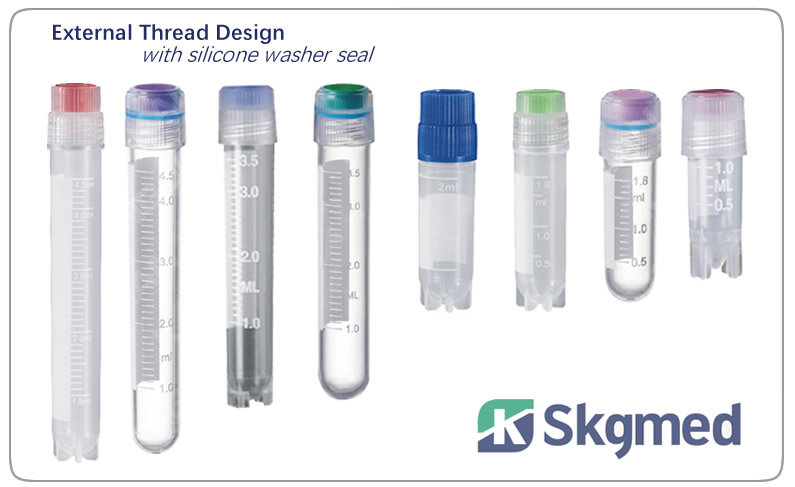
Cryovials: These feature specialized thread designs. You can choose between internal and external threads. External threads reduce contamination risk because the thread remains outside the sterile interior. Internal threads maximize storage density in crowded freezer racks. They also utilize specialized O-rings, often made of silicone, or bi-injected seals. These seals maintain their integrity even when the plastic contracts at -196°C.
Centrifuge Tubes: These generally use flat or plug-seal caps. A plug seal pushes a plastic ring down into the tube neck. This design is highly effective for liquid retention during high-speed spinning. It also prevents leaks during horizontal transport. However, it is vulnerable to microscopic leaks under extreme thermal contraction. The cap and the tube may contract at different rates, breaking the seal.
Temperature Tolerance & Safety Protocols
Temperature limits define the operational boundary of every plastic consumable in your lab.
Cryogenic Storage Vials: These vessels are rated for ultra-low temperatures. You can safely store them at -196°C. Implementation Risk: You must use them in the vapor phase of liquid nitrogen, not the liquid phase. Liquid nitrogen can seep into the threads of almost any submerged tube. Upon thawing, the trapped liquid rapidly expands into gas. This expansion causes explosive thawing unless the tube is explicitly encased in protective secondary tubing.
Laboratory Centrifuge Tubes: These are typically safe down to -80°C. You must verify specific manufacturer polypropylene specifications before freezing. Below this threshold, the polymer becomes highly brittle. The slightest impact or thermal shift can cause the plastic to shatter, completely destroying the sample inside.
Centrifugal Force (RCF) Ratings
Physical separation requires intense mechanical force. You must match the vessel to the rotor.
Centrifuge Tubes: Manufacturers specifically test and rate these for high-speed spinning. Many high-quality microcentrifuge tubes withstand 15,000+ x g. Conical tubes often endure up to 12,000 x g. Their geometry supports the pelleting of cells and precipitation of nucleic acids.
Cryovials: These are not universally designed for high-speed centrifugation. Their flat or skirted bottoms do not distribute g-forces efficiently. Spinning them beyond manufacturer limits risks micro-fractures. In severe cases, the cap or base will fail entirely inside the rotor.
The Hidden Costs of Misaligned Tube Selection
Using the wrong tube does more than just break plastic. It introduces systemic failures across your entire laboratory workflow.
Cross-Contamination Risks
Using standard tubes for cryopreservation directly threatens sample purity. A plug-seal cap on a standard tube will likely fail in a deep freeze environment. When the seal fails, the sample is exposed. If stored in liquid nitrogen vapor, the sample can absorb contaminants from the shared vapor environment. Conversely, a leaking tube can cross-contaminate the entire freezer, putting every other stored asset at risk.
Sample Loss and Irreproducibility
Micro-fractures are a silent killer of biological research. When you subject non-cryogenic tubes to ultra-low temperatures, invisible hairline cracks form. Over time, these micro-fractures cause gradual desiccation. As the water content evaporates (lyophilizes), the concentration of salts and solutes increases. This causes severe pH shifts. By the time you thaw the sample, the biological material is degraded. This invalidates downstream assays and destroys experimental reproducibility.
Operational Inefficiencies
Forcing a "one size fits all" consumable strategy harms laboratory productivity. Trying to save money by using only one type of tube increases downstream labor costs. For example, technicians might spin down cells in a standard tube, then manually transfer the pellet to a cryovial for archiving. Repeatedly transferring samples wastes valuable labor hours. More importantly, every manual transfer increases the risk of pipetting errors and external contamination.
Decision Framework: Shortlisting Logic for Lab Procurement
You need a standardized approach to consumable procurement. Following a clear decision framework ensures you buy the right tool for the exact task.
Assess the Workflow End-Goal
Your immediate next procedural step should dictate your vessel choice.
Separation and Processing: If the immediate next step is separation, pelleting, or phase extraction, default to a laboratory centrifuge tube. It provides the necessary mechanical strength.
Archiving and Preservation: If the immediate next step is archiving in a mechanical freezer (-150°C) or LN2 dewar, default to a cryogenic storage vials. It provides the necessary thermal resilience.
Evaluate Storage Duration
Time is a critical variable in preservation planning.
Short-Term Holding: If you only need to hold samples for days or weeks at -20°C or -80°C, you can safely manage this with high-quality centrifuge tubes.
Long-Term Biobanking: If you plan to archive samples for months or decades, you strictly require specialized cryogenic vessels. Standard plastics degrade over long periods of deep freezing.
Budget and Scalability
Procurement teams must balance unit costs against operational needs. Centrifuge tubes offer lower unit costs, making them ideal for bulk, high-throughput daily processing. Conversely, highly engineered cryogenic tubes carry a premium unit cost. Reserve these higher-cost items specifically for the archival stage of the workflow. This strategy optimizes your consumable spend without compromising sample security.
Evaluation Parameter
Cryovials
Laboratory Centrifuge Tubes
Primary Purpose
Long-term archival & biobanking
Active processing & separation
Temperature Limit
Down to -196°C (Vapor Phase LN2)
Down to -80°C (Verify material)
Seal Mechanism
O-ring or bi-injected seal (extreme integrity)
Plug seal or flat cap (moderate integrity)
RCF Tolerance
Low (Not for high-speed spinning)
High (Up to 15,000+ x g)
Unit Cost Profile
Premium (Reserved for archiving)
Economical (Ideal for bulk benchwork)
Best Practices for Standardizing Laboratory Storage
Proper vessel selection is only half the battle. You must implement strict operational habits to secure your laboratory workflows.
Labeling and Tracking
Clear identification prevents disastrous mix-ups. Adopt 2D barcoded vessels for scalable biobanking. Hand-written labels fail in deep freeze environments. Standard marker ink degrades, smudges, or flakes off entirely when exposed to frost and ethanol wipes. A permanently etched 2D barcode ensures your sample remains identifiable decades after initial storage. This is a non-negotiable standard for modern biobanking.
Standard Operating Procedures (SOPs)
Your lab must document and enforce strict filling limits. Mandate clear volume limits in your standard operating procedures. Water expands by approximately 9% when it freezes into ice. Overfilling any tube before freezing leads to massive volumetric expansion. This internal pressure causes structural cracking, forcing the cap off or shattering the base. Always leave adequate headspace.
Material Compatibility Reviews
Temperature is not the only stressor on lab plastics. Solvents and harsh chemicals degrade certain polymer blends. Regularly audit your lab procurement protocols. Ensure the polymer grade of your processing tubes matches the solvents or chemicals being stored. This rule applies regardless of the storage temperature. A chemical incompatibility can cause a tube to melt or leach plasticizers into your sample.
Conclusion
The decision between these two critical consumables comes down to a choice between preservation security and processing utility. You cannot force one vessel to perform both extremes safely.
Do not compromise on consumables. Implement strict operational boundaries in your laboratory. Reserve high-RCF tubes for active benchwork and moderate freezing. Dedicate highly engineered cryogenic vessels exclusively for ultra-low temperature archiving.
Your immediate next step is to review your current laboratory freezing protocols. Audit the lab’s consumable inventory today. Ensure your daily operational habits align perfectly with standard biobanking safety requirements.
FAQ
Q: Can you freeze a laboratory centrifuge tube?
A: Yes, typically down to -80°C, provided the tube is made of appropriate medical-grade polypropylene and not overfilled. They should never be used in liquid nitrogen. Extreme cold makes standard plastics brittle, leading to micro-fractures or complete structural failure.
Q: Are external thread cryovials better than internal thread?
A: External threads limit sample contamination by keeping the thread outside the sterile interior, but they take up slightly more space. Internal threads save space in crowded freezers but carry a slightly higher risk of cross-contamination if liquid enters the thread ridges.
Q: Can you put a cryovial in a centrifuge?
A: Only if the specific vessel has an RCF rating provided by the manufacturer. Most standard long-term storage vessels are not designed to withstand high centrifugal forces. Spinning them risks micro-fractures, cap failure, or complete breakage inside the rotor.
Q: Why do tubes explode when taken out of liquid nitrogen?
A: If a non-cryogenic tube (or an improperly sealed vial) is submerged in the liquid phase of LN2, liquid seeps inside. Upon thawing, the trapped liquid rapidly expands into gas, causing the tube to rupture explosively. Always store vessels in the vapor phase.